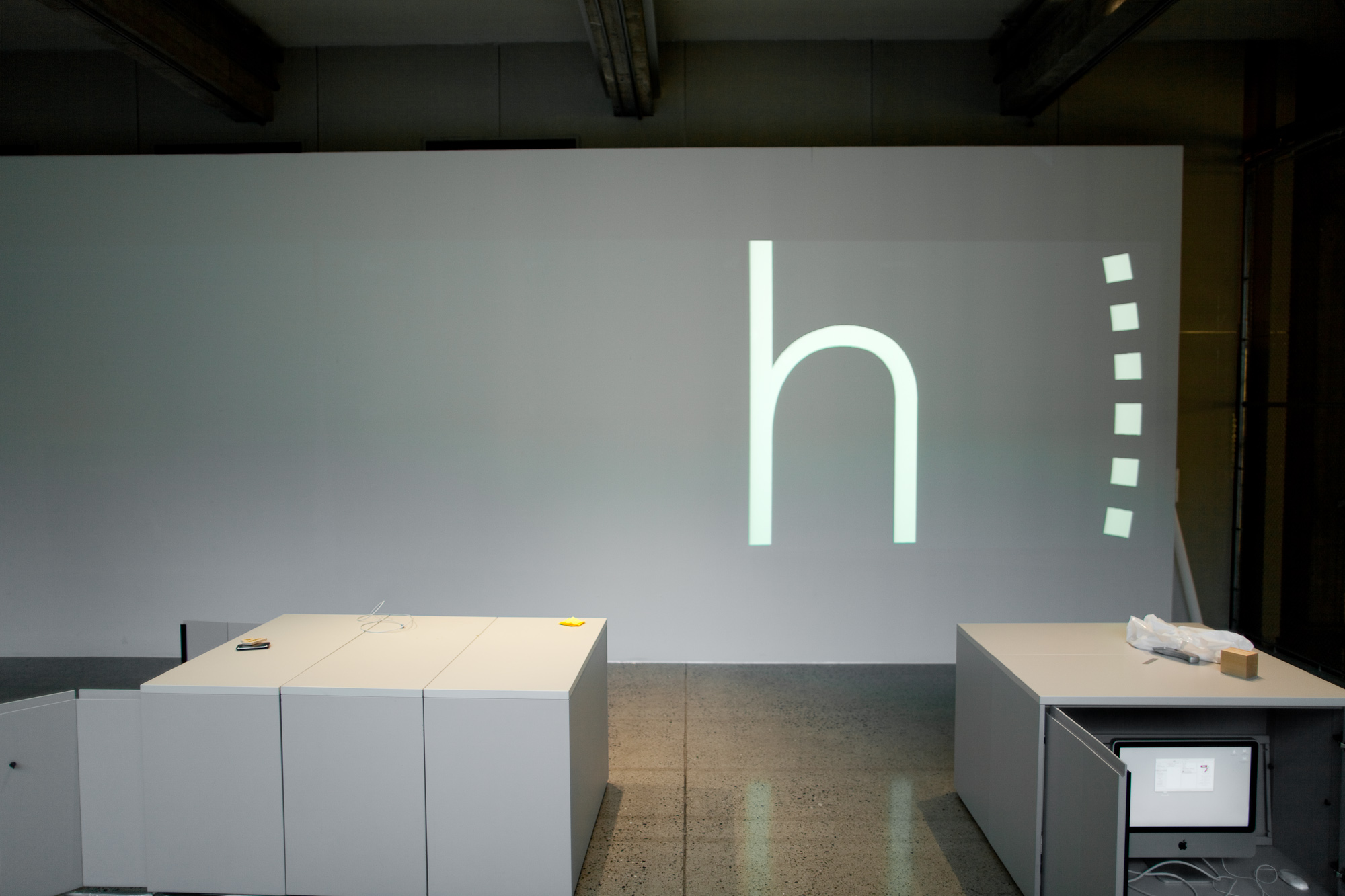
Touch has an exhibition at Nordes’09 Engaging Artifacts that is taking place at AHO from Sunday 30th August until Wednesday 2 September 2009. Nordes is the Nordic Design Research Conference and this event brings together designers and researchers under the theme of “Engaging artefacts”.
Today has been spent setting up the exhibition space, which consists of three interactive installations that show various aspects of Touch design, innovation and research work including Anne Galloway’s Re/touch and many of the Touch design projects.
The exhibition itself is free to the public, so if you are in Oslo please drop by, and there will be more on the exhibition here next week.
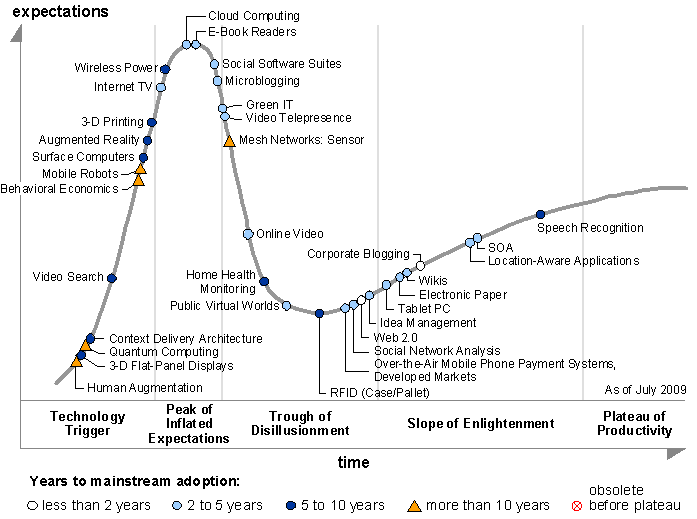
Last week Gartner released their hype cycle for technologies in 2009, and what do we find at the very bottom of the trough of disillusionment?
The hype and doom predictions around RFID and NFC have been fun to watch, but we’re happy to be working with a technology that is now mature and cheap enough to be useful. (We disagree with ReadWriteWeb that it is fear of RFID that is potentially killing Violet, more like a lack of compelling user-experience).
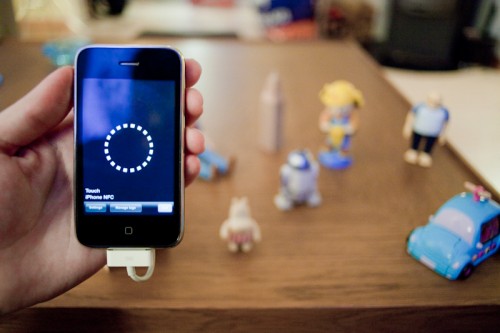
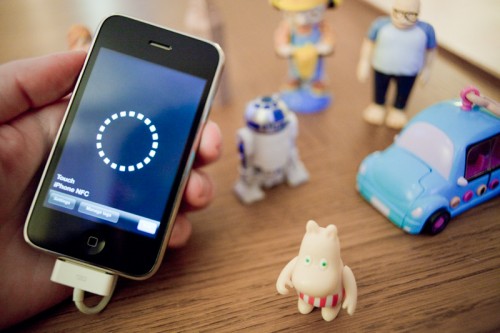
This is a video prototype of an iPhone media player that uses physical objects to control media playback. It is based on Radio Frequency Identification (RFID) that triggers various iPhone interactions when in the range of a wireless tag embedded inside a physical object.
RFID is becoming more common in mobile phones (under the term Near Field Communication or NFC) from manufacturers such as Nokia. By looking at Apple’s patents we know that the technology is being considered for the iPhone. With the iPhone SDK 3.0 external hardware accessories can be accessed by iPhone software, so third party RFID or NFC readers are also possible.
So what kinds of applications would emerge if an iPhone had an NFC reader? Here we have prototyped a simple media player, which triggers the playback of content on the touch of a tag, and created a set of augmented objects that have relationships to different kinds of audiovisual content.
A lens for media
Compared to other mobile handsets the iPhone is a particularly media-friendly device, with a large, bright screen and high quality audiovisual playback. What if this screen could act as a ‘lens’ to content that resides in the world?
In a screen-based interface content may be buried many levels deep inside an information architecture. But in a physical RFID-driven interface a simple gesture can offer quick and direct access to content. Physical objects afford tangible manipulation that screens cannot, and this is great for playful products. Our Bowl prototype showed a natural blending of media consumption and playful activitiy in children, where media viewing became less passive and a more active experience.
In this video demo, the objects have been chosen to physically or visually represent the content. There are some obvious relationships, such as the Moomin figure leading to a favourite episode of a Moomin animation. The less obvious relationships such as the wooden house leading to home videos were chosen because they just somehow felt right. In fact the exact relationship may be of secondary importance, as over time the behaviour of the physical and digital objects becomes known and transparent through exploration and repetition.
Some of the objects felt particularly satisfying. The Make Podcast object for instance—where touching the ‘geek’ plays the latest ‘Weekend project’— shows how an object can be used for exploring a dynamic stream of content.
Going further
This video prototype is basic and intended to open up for discussion and new exploration around the experience of media selection through physical objects. At the moment the interaction is a trigger, but what if the phone doesn’t just react as output but also as input to physical objects? How do we programme and manage our sets of media and applications in these objects?
Overall this points towards opportunities around the distribution of media through physical objects, it is an example of general ideas around an ‘internet of things’ or ‘spimes’ applied to the world of media. What opportunities would the distribution of RFID-embedded products open up in terms of media, gaming, services and marketing? What does this mean for the future of products?
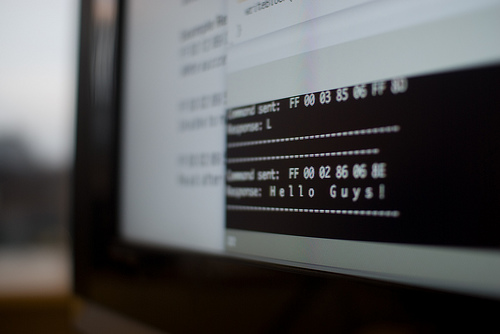
Last year we made a Processing library for the Sonmicro SM130 RFID read/write module together with Jørn Knutsen and Tom Igoe. The SM130 is a little module that lets you read and write to Mifare RFID tags. The Sonmicro Processing library is a good and flexible tool for exploring RFID interactions. One of the things we have been doing with it is playing with the London Oyster card and writing messages to the memory on our office access-cards.
In a future post we will look more closely on the technicalities of designing behaviours with RFID readers, presenting our tools for both the Sonmicro SM130 and the Innovation ID12.
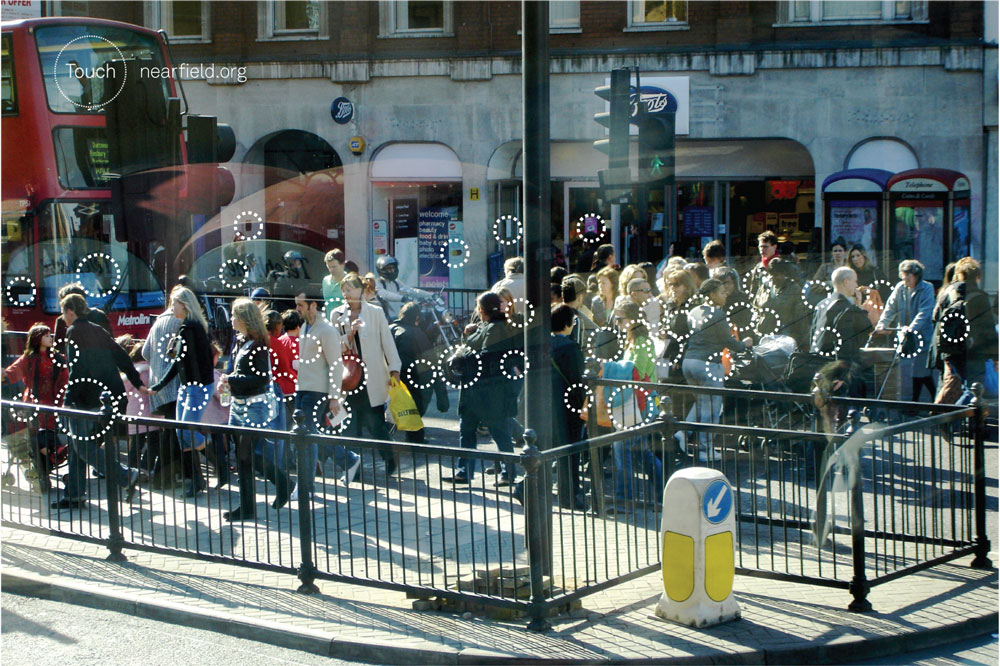
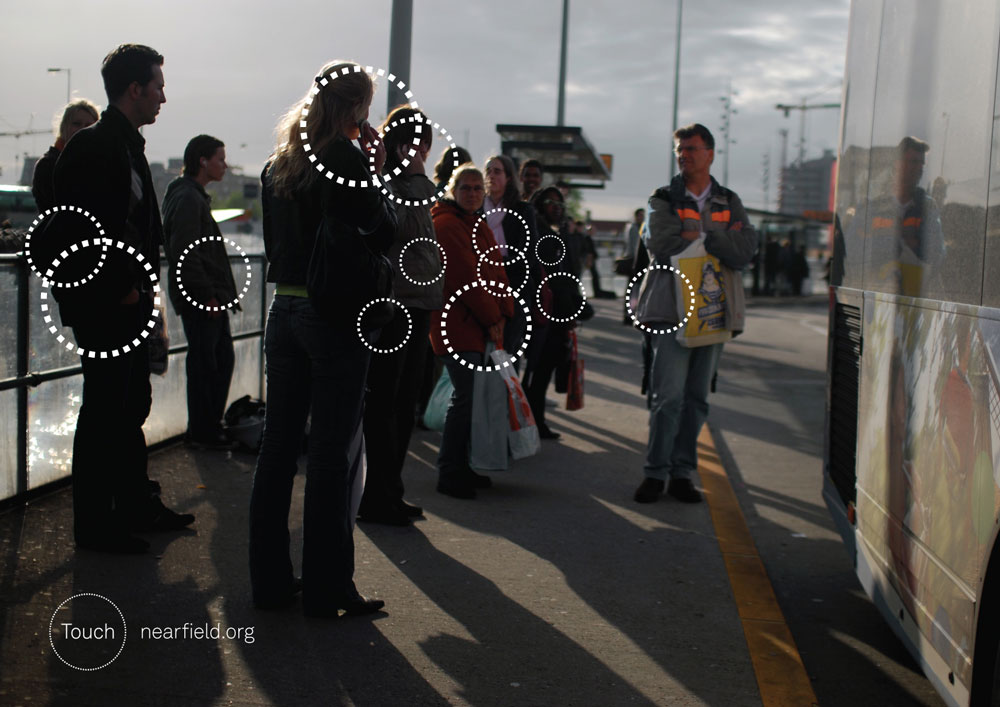
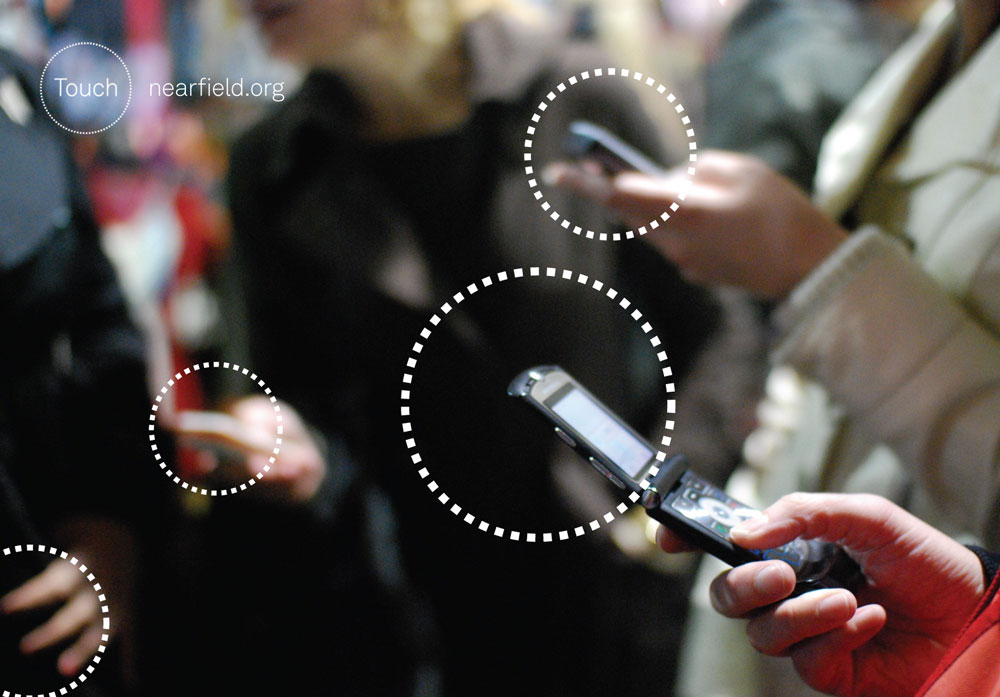
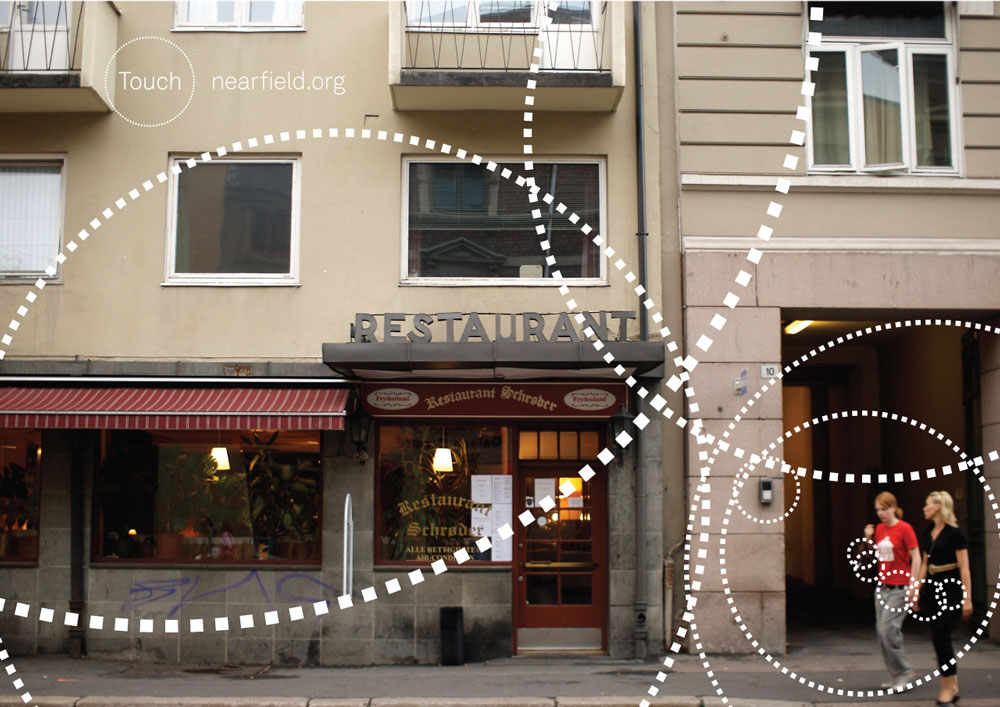
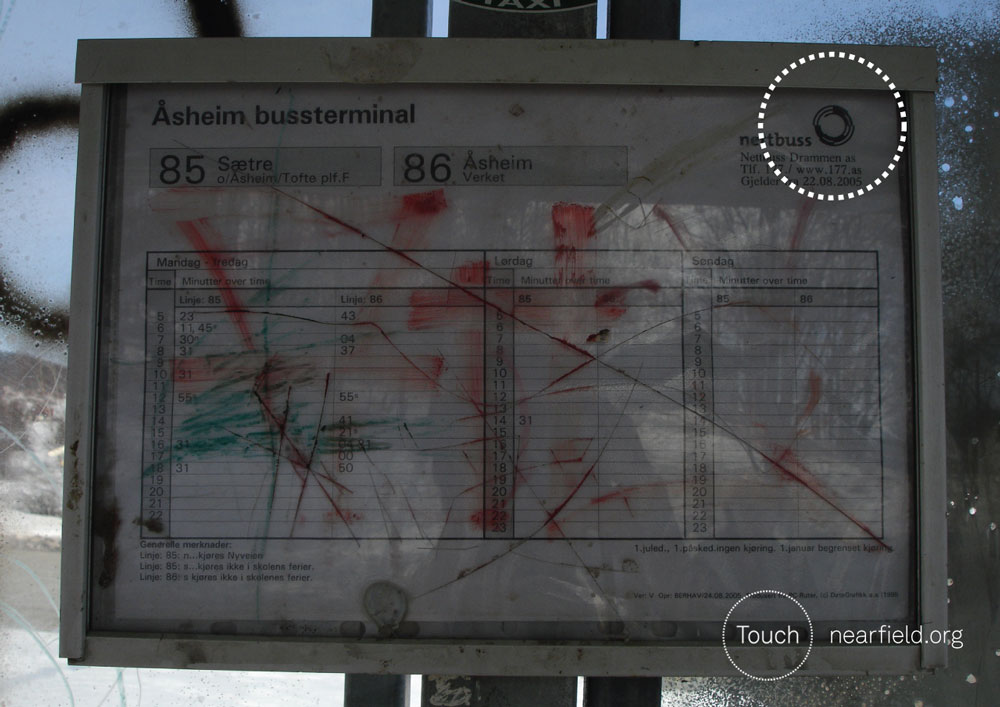
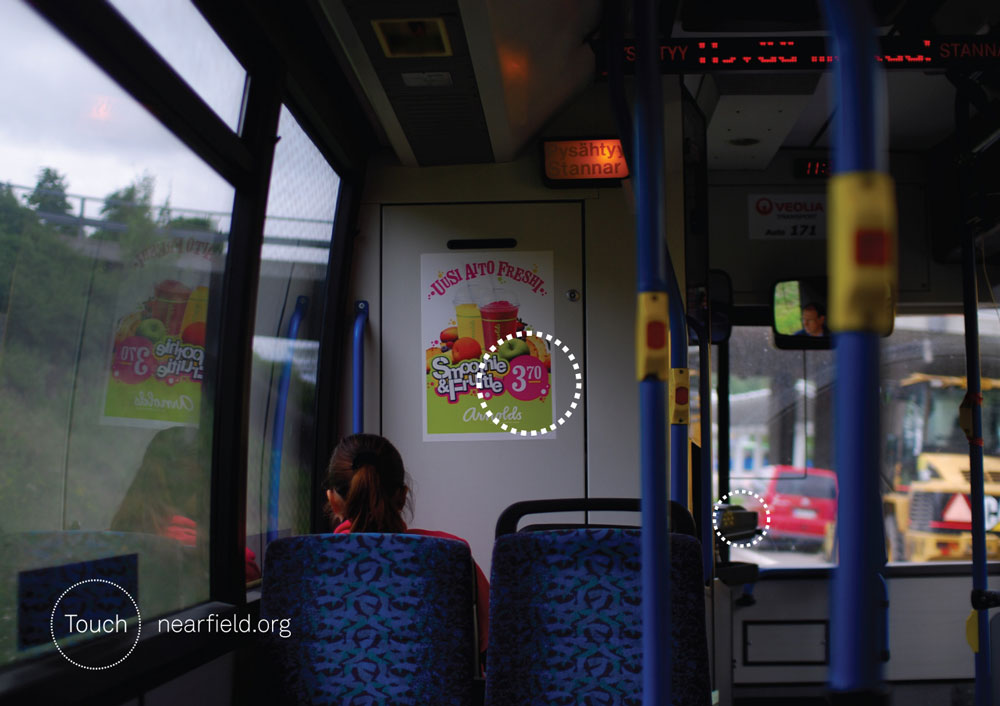
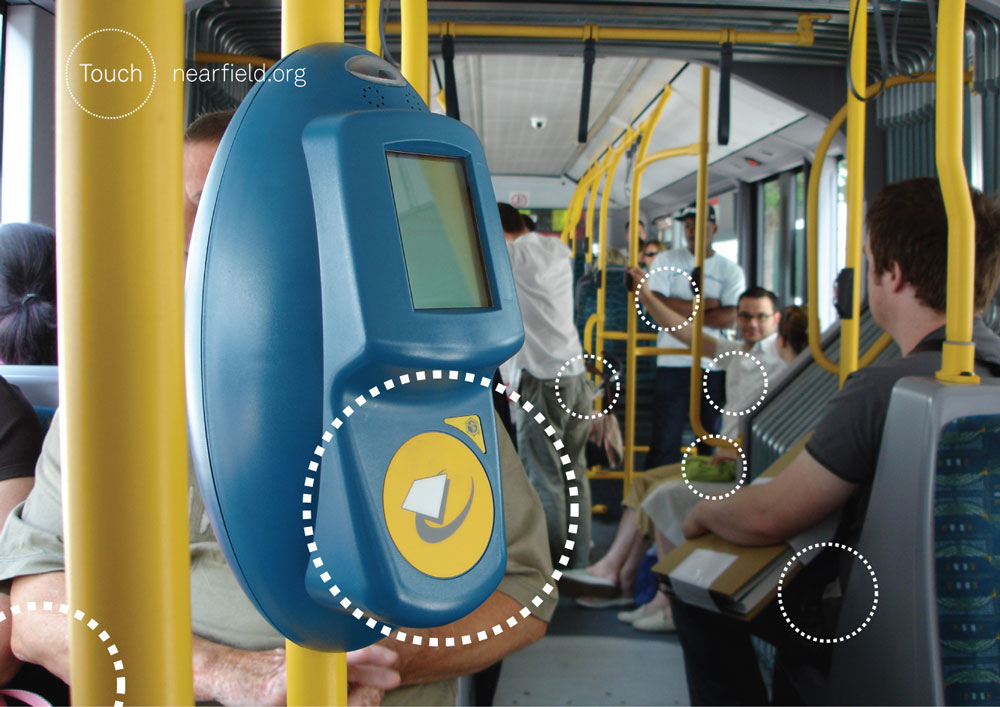
Right now I am sitting near fourteen objects sending and receiving radio signals, from Oyster cards to mobile phones and wireless routers in a multitude of overlapping and competing fields. Here we are creating communicative material that uses dashed-line abstractions to visualise the presence of wireless technologies in the everyday environment. What if we could see every field produced by an Oyster card or NFC enabled mobile phone for instance?
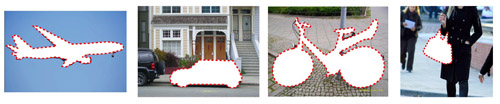
Using simple abstractions such as the dashed line and the kinds of visual language that we have previously proposed for RFID allow us to quickly communicate aspects such as the spatial properties of wireless technologies that are often overlooked. I’ve been using these images in presentations for a while, to sensitise designers and students to the spatial and embodied properties of RFID, Bluetooth and WIFI.
We are also experimenting with video, where the visualisations are part of an environment in a moving sequence. This is looking like a useful technique for making visual explanations of invisible materials.
We recently had the chance to present Touch at the event Kreative Oslo 09 at DogA, the Norwegian Center for Design and Architecture. Kreative Oslo is a broad seminar that gathers the creative fields in Oslo, including art, design, research, commercial actors, cultural institutions etc.
Presenting Touch at a event like this is a good opportunity to provide a glimpse into ongoing design and research and a chance to communicate to a broader audience. The talk focused on design as an approach to RFID and how we can use design to understand, communicate and explore emerging technologies.
The presentation consists of condensed presentation of RFID from a technical and material perspective and goes on to describe various aspects of designing with RFID. In this presentation we use the Touch-projects Bowl and Sniff to illustrate the process of designing RFID products. The presentation is available on Slideshare.
Mike Kuniavsky presented at ETech 2009 on the Dotted-Line World on the links between ubiquitous computing and service design, where subscription-based services are based on everyday objects.
(I’m a big fan of dotted or dashed lines, it’s a great visual trick for representing hidden things. Glad to see that Mike is taking up this language, we should develop it further!)
Here’s the description of the talk in full, the slides are available from slideshare and at Mike’s weblog:
Things have long had identifying marks, from silversmiths’ hallmarks to barcodes, but mating machine-readable identification with pervasive networking greatly increases the value of the marks.
For example, when a machine-readable identification method such as an RFID or a high-density visual code is combined with the wireless networking of a mobile phone, a new way of interacting with everyday objects is created. Once you have the capability uniquely identify anything immediately, you can attach meta information to it. Any meta-information. How much is this worth on eBay? Which of my friends has one? Will this go with my Mom’s china? Will it make me sick if I eat it? Was it made by children?
I call this digital representation as accessed through a unique ID, an object’s “information shadow” and I now see them attached to just about everything. Beyond getting meta information, however, lies an even more powerful concept: changing the physical object to a service, for which the thing you’re looking at is but a single instantiation of that agreement. It’s already happened to media, and to car-shared cars and shared bicycles in urban areas.
When this happens, the objects have to change at a fundamental level. They have to be designed differently and they have to be described and discussed differently. The “owner’s” relationship to the object changes. The very idea of ownership changes. The solid object grows a dotted line that is filled-in as-needed, when-needed, and with the features that are needed. This is not the same thing as renting or co-ownership, its anytime/anywhere nature-enabled by the underlying technology makes these new service objects fundamentally new.
Many recent products point in this direction, where objects such as the Amazon Kindle are useless without the service contract, where a Nabaztag/tag is an empty shell waiting for connection to a network full of personal information and social connections, and where NFC phones and RFID peripherals are just the touchpoints between the online and the offline.
Conferences make great places for relatively large scale testing grounds of new technologies, with their self-contained setting, physical venues, registered participants and impetus for social networking. Two years ago we built our RFID photo booth at Picnic 07, which was a huge success. Since then Mediamatic has run the experiment again and has been nominated for a SpinAward award for the emerging ikTag and Interactive Social RFID Games.
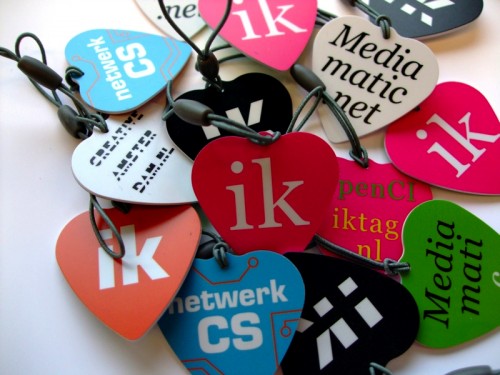
The ikTag is an extremely simple interface for social networks, both on and offline. Mediamatic developed the ikTag for people to do nice stuff with their online profile without sitting behind your computer. The ikTag is an innovative and cultural application of RFID technology.
That’s why we are giving all of the attendees at ETech RFID tags that can be linked to their conference profiles. Activating your RFID tag and linking it to your profile will be completely opt-in, but with these tags you can interact with several projects we’ll have at the conference.
As we discovered with the Picnic photo booth, there are lots of interesting opportunities to be discovered when a physical tag is linked to a social network…
Touch is a research project that investigates Near Field Communication (NFC), a technology that enables connections between mobile phones and physical things. We are developing applications and services that enable people to interact with everyday objects and situations through their mobile devices. More...